Stack Data Structure
What is a Stack?
A stack is a fundamental data structure that follows the Last-In-First-Out (LIFO) principle. Think of it like a stack of plates - you can only add or remove plates from the top. The last plate you put on (push) will be the first one you take off (pop). Stacks are fundamental in Computer Science as lot of concepts releated to compilers and program execution deal with stack memory. So this is essential to building a solid foundation when it comes to thinking about memory as well.
Overview
Stack is a Abstract Data Type (ADT). So stacks can be implemented using arrays, linked lists etc. The idea here is to understand the concept of stack and then provide a way to implement one using arrays. Once you grasp the concept, you can choose to implement it using linked lists or queues.
Key Operations
- Push: Add an element to the top of the stack
- Pop: Remove the top element from the stack
- Peek/Top: View the top element without removing it
- isEmpty: Check if the stack is empty
Brief Introduction
To get a brief understanding of stacks, watch this excellent short video:
Working of Stack
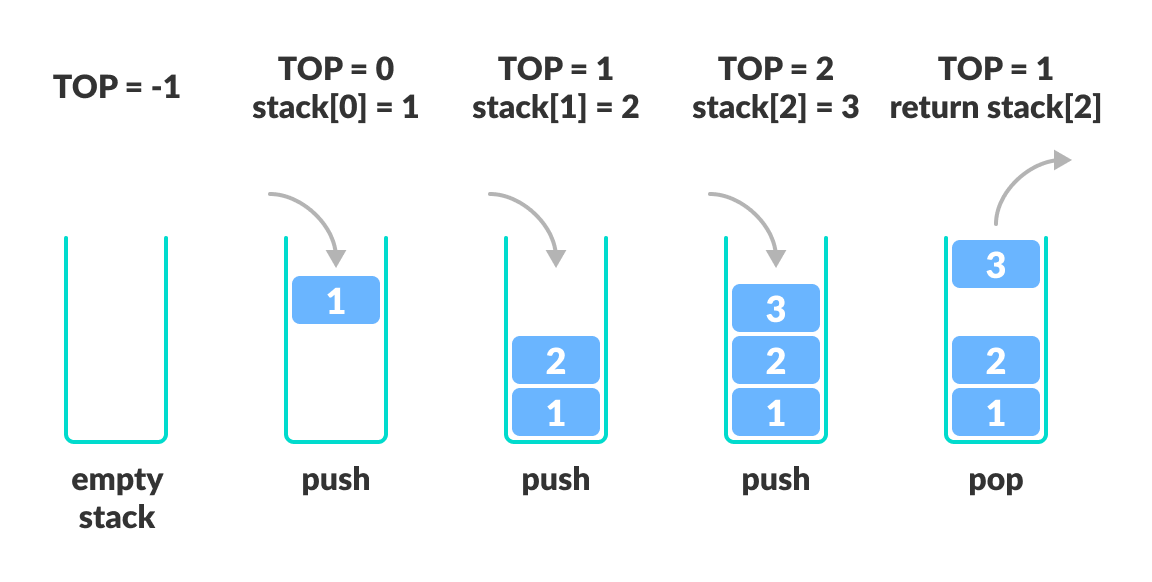
The operations work as follows:
- A pointer called TOP is used to keep track of the top element in the stack.
- When initializing the stack, we set its value to -1 so that we can check if the stack is empty by comparing TOP == -1.
- On pushing an element, we increase the value of TOP and place the new element in the position pointed to by TOP.
- On popping an element, we return the element pointed to by TOP and reduce its value.
- Before pushing, we check if the stack is already full
- Before popping, we check if the stack is already empty
Interactive Playground
Try implementing a stack in Python! The playground below provides a template where you can code your own stack implementation. You’ll learn by doing! Please close the sidebar by clicking on the sidebar close icon to have a nicer coding experience.
Loading playground...
Time Complexity
| Operation | Time Complexity |
|---|---|
| Push | O(1) |
| Pop | O(1) |
| Peek | O(1) |
| isEmpty | O(1) |
Tips for Implementation
- Always check if the stack is empty before popping
- Consider edge cases in your implementation
- Think about size limits if using array implementation
- Remember that peek operation should not modify the stack
Remember: Understanding stacks is crucial for both coding interviews and real-world applications. Take time to practice with the interactive playground above!
Common Use Cases
- Function Call Stack: Managing function calls and their local variables
- Undo/Redo Operations: Tracking history of actions in applications
- Browser History: Managing back/forward navigation
- Expression Evaluation: Parsing and evaluating mathematical expressions
- Valid Parentheses: Checking for balanced brackets in code